INSIDE SCOOP
Exploring places, things, and people of UMCA
The Christ
Thanks to Anacortes American for allowing us to use this article written in 1988 by NANCY WALBECK , Anacortes American staff writer. To view the actual article, click here.
Discovery in the Grove
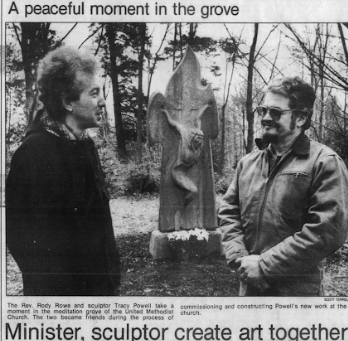
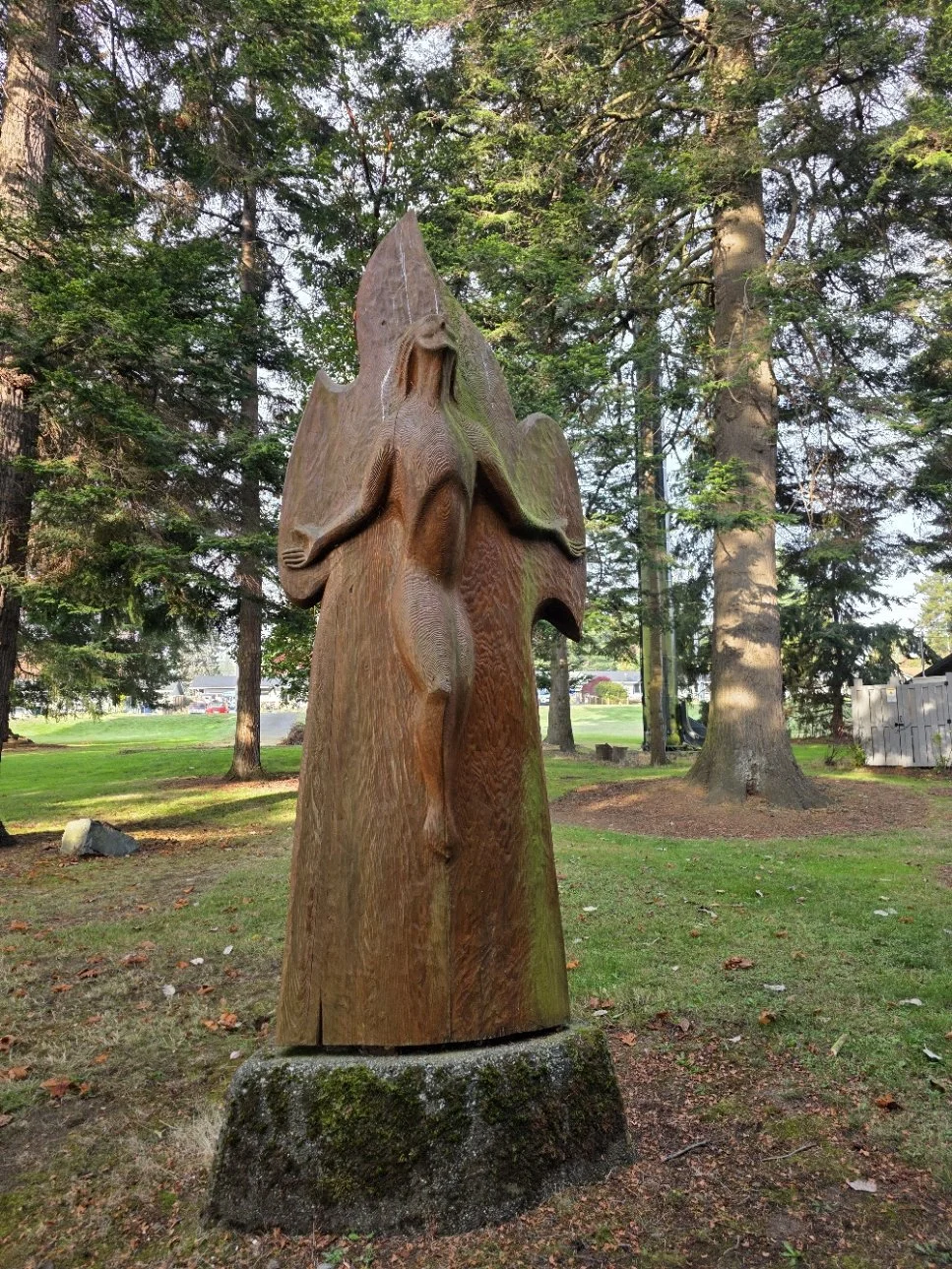
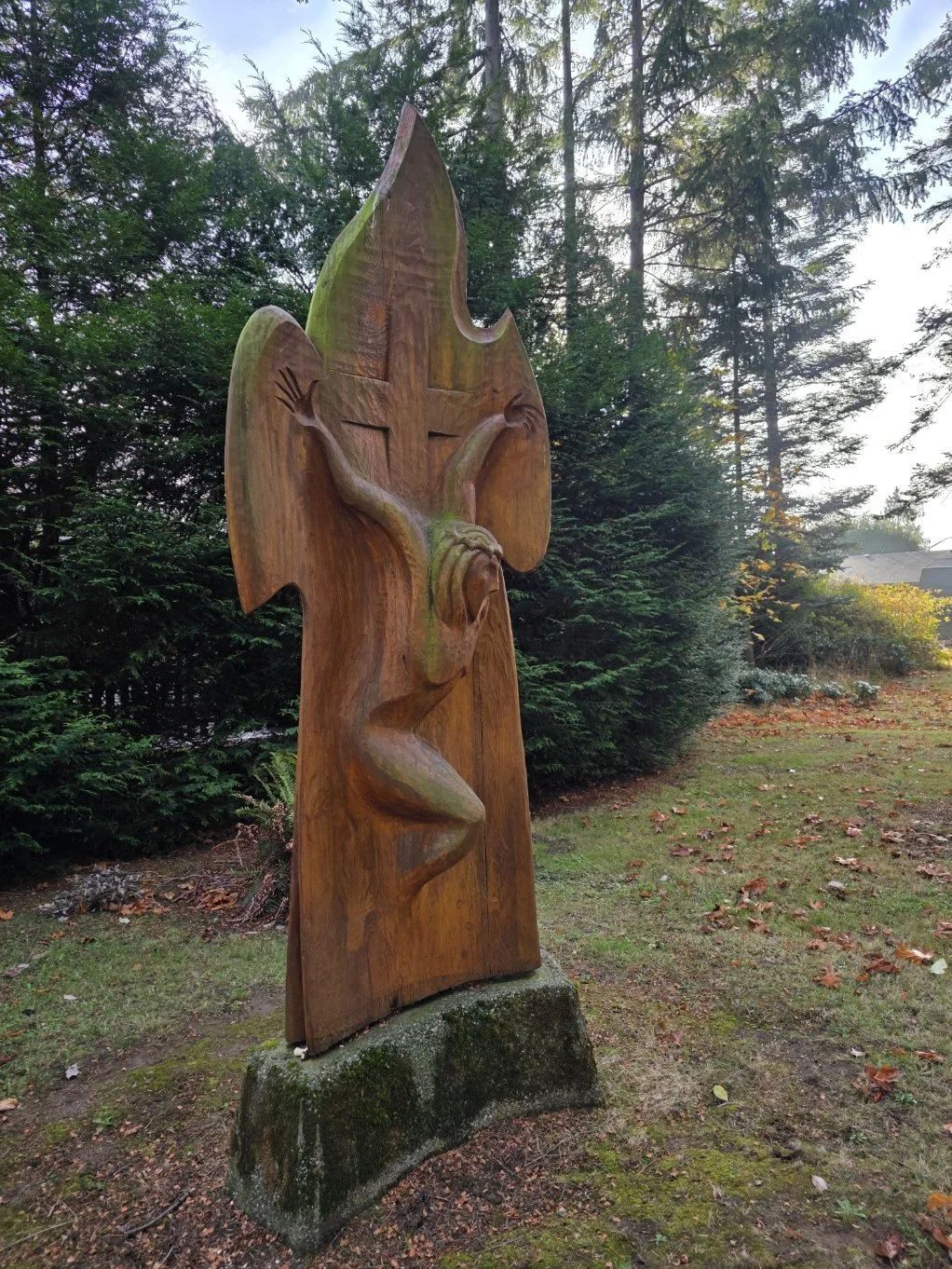
You find it in an unexpected place under the canopy of sheltering trees in the Meditation Grove at UMCA. Although man-made, it belongs here through a merging of divine inspiration and spiritual artistry. It is The Crucified and Risen Christ, a red cedar representational statue carved by Anacortes artist Tracy Powell in inspired collaboration with UMCA Rev. Rody Rowe. In November 1988, the statue was dedicated in its permanent home in the Meditation Grove adjacent to the church building at 22nd Street and H Avenue.
A Vision for All People
To mediate in this grove is to engage life, not to withdraw from it. “We need places like this. It makes a statement how we view the inner life with God,” Rowe said. “It’s the suffering and the joy. It is a mixed thing. (When you come to the garden) you can be challenged and comforted.
The grove was designed to include all who could, or would, need the peace of mind the setting exudes. Rowe believed that "we need places like this. It makes a statement how we view the inner life with God." The garden was intended not simply as a church space, but as a community sanctuary where people could be challenged and comforted. "People are invited to come and be there anytime, day or night. It is not ours; it is everybody's," Rowe said.
The Collaboration
The vision for the piece originated with Rowe, and it was he who approached Powell about a ‘‘story pole” of Jesus Christ. Powell, who at that time was the City Parks Forest Manager. His eyes lit up. “I had to slow him down,” Rowe said, chuckling with the memory. Rowe said he knew of Powell’s evocative ‘‘Maiden,” a carved cedar work overlooking Rosario Straits, but not the artist himself. “He introduced himself. It was the Arts and Crafts Festival in August of 1987,” the 43-year-old Powell said. “He said, ‘I have this vision of Christ crucified and resurrected.’ lt was just a shock to me.’ I said, ‘please let me do this,'” Powell said. “The whole thing popped into my head. I wanted to do it that afternoon.”
From the beginning, Powell saw the work as a shared endeavor. He spent countless hours talking with Rowe, learning how he understood Christ and Christian spirituality, determined to bring those ideas into a tangible form. "It's a shared vision, the piece," Powell explained.
Creating the Sculpture
Rowe was determined that Powell be commissioned and paid as an affirmation of his artistry. The 250-member congregation raised the $5,000 commission through donations honoring memories of church members and others. Powell carved the sculpture from a 400-year-old red cedar from the Upper Skagit forests, using traditional tools including a chain saw, adze, axe, chisel, and gouge. The log had also produced a canoe for the Samish Tribe. Once the project began, Powell spent about three months carving, describing that period as the natural length necessary for the piece. "The piece imposed its own time pattern. I can't force it; I can't rush it," he said.
Symbolism and Meaning
The sculpture stands nearly life-size, mounted so that the morning sun first strikes the resurrected Christ. As the sun moves west, shadows slip down the crucified Jesus, slowly revealing the suffering figure. The duality is central to the artwork: dying and risen, suffering and joy. Rowe noted that "the suffering figure is much more accessible. The suffering God is so reachable." The stark, spare beauty of the piece conveys both pain and hope, inviting reflection on the realities of human life and faith.
Community Legacy
Beyond its artistic and spiritual significance, The Crucified and Risen Christ has become a lasting community landmark. Conceived as a gift not only to the congregation but to the wider community, the Meditation Grove continues to offer a place of peace, healing, contemplation, and renewal. The sculpture embodies the trust and shared vision between pastor and artist, while serving as a reminder that art, spirituality, and community are deeply connected. As Powell reflected, "The most important thing in this whole deal is that Rody trusted me with his vision and expected me to do something with it."
Powell said he has always felt the spiritual and the artistic, that duality in each of us, cannot be separated one from the other. This philosophy could serve as a metaphor for the shared visions of these two men as well. “To me, the artistic and the spiritual are the one thing. But I do think the Christ I made is Rody’s Christ,” Powell explained. “It was my intent to incorporate him in it (the artwork). The most important thing in this whole deal is that Rody trusted me with his vision and expected me to do something with it,” Powell said. “Does he really like it? He’ll probably never say. But I watch him, watching it.”
The Labyrinth at UMCA - what you may not know
Overview
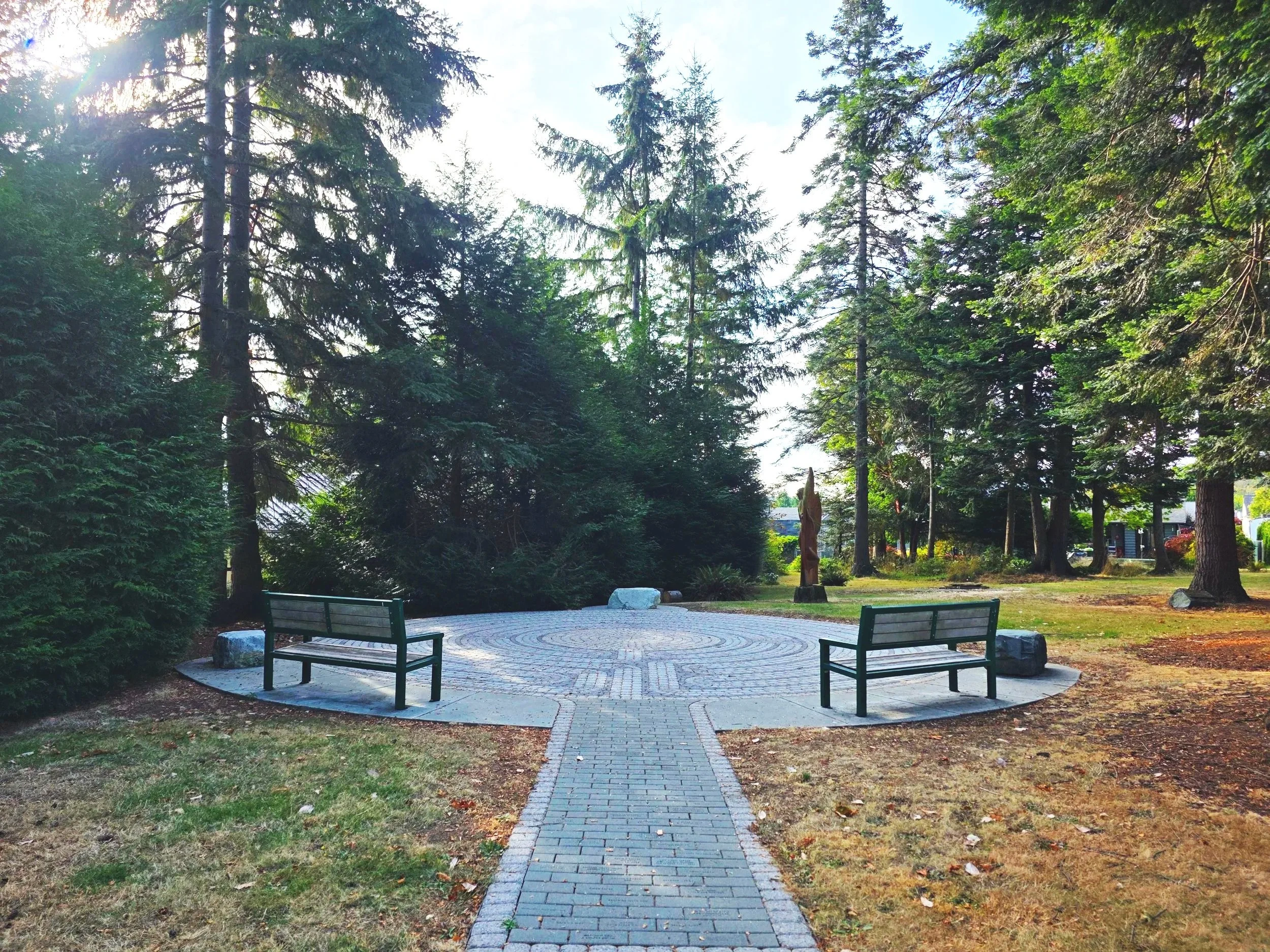
Located on the grounds of the United Methodist Church of Anacortes, the labyrinth offers a quiet and welcoming space for prayer, meditation, and reflection. Completed in 2012, The Labyrinth Company designed this 30-foot Medieval 8-circle labyrinth. This space offers opportunities to pause, breathe, and walk at one’s own pace.
What Is a Labyrinth?
A labyrinth is not a maze. With one path leading inward and the same path guiding walkers back out, it offers a simple and meaningful way to slow down and reflect. The journey can symbolize movement toward the center of one’s deepest self and a return to the world with renewed awareness, calm, and perspective.
Many visitors experience a labyrinth walk in three gentle stages. The path inward may be a time to release worries and stress. The center offers a moment for stillness, prayer, or listening. The return path provides space to carry fresh insight or renewed peace back into everyday life. Each walk is personal, and people find it meaningful whether they arrive with a specific intention or simply a desire for quiet.
History and Funding
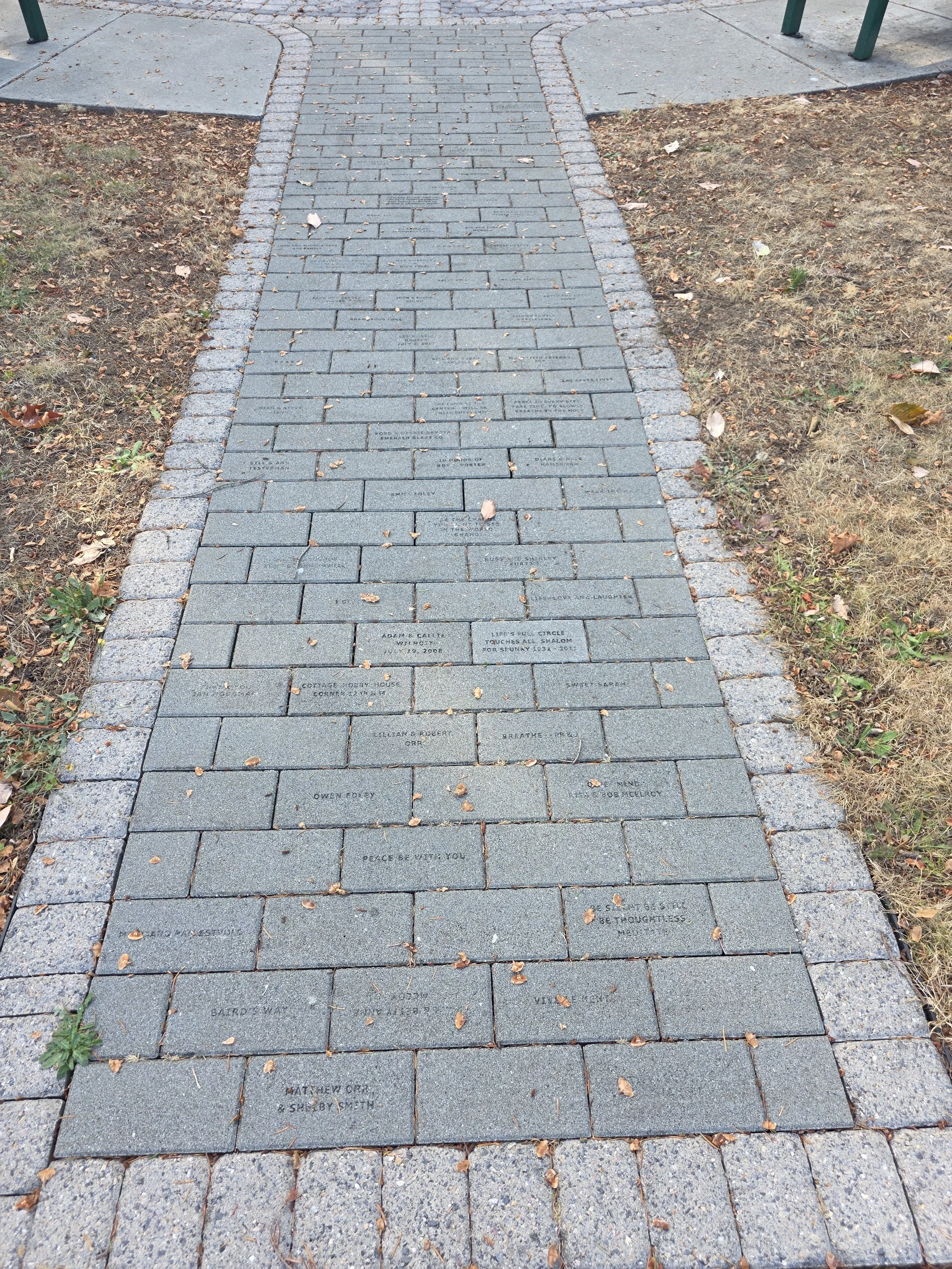
The labyrinth was completed through a partnership between the Anacortes Park Foundation and the United Methodist Church of Anacortes. Community support helped bring the project to life – approximately $10,000. Funding was raised through engraved commemorative bricks, available for $50 with one line of text or $100 with two lines. Additional support came from Island Rentals, Lakeside Industries, Lang Construction, Mammoth Stoneworks, the Samish Indian Nation, Strandberg Construction, Scout Troop 4081, and many individuals who contributed funds, time, equipment, and materials.
Spiritual Practice and Community Setting
The United Methodist Church of Anacortes supports practices that encourage contemplation, prayer, and spiritual formation. Alongside traditional worship services, the congregation offers meditation opportunities and other gatherings that nurture personal spiritual growth. The labyrinth complements these practices by providing a dedicated outdoor space for quiet reflection at an individual pace.
The church’s setting adds to the labyrinth’s sense of welcome. Located in Anacortes, a community known for its natural beauty and maritime surroundings, the church offers an accessible place of retreat within the city. Members, neighbors, and visitors are invited to experience the labyrinth as part of the congregation’s broader commitment to hospitality and spiritual renewal.
The labyrinth offers a peaceful invitation to slow down, pay attention, and reconnect. Whether used for prayer, meditation, or personal reflection, this welcoming path provides a meaningful way to seek greater awareness and inner calm. The labyrinth is open to all.